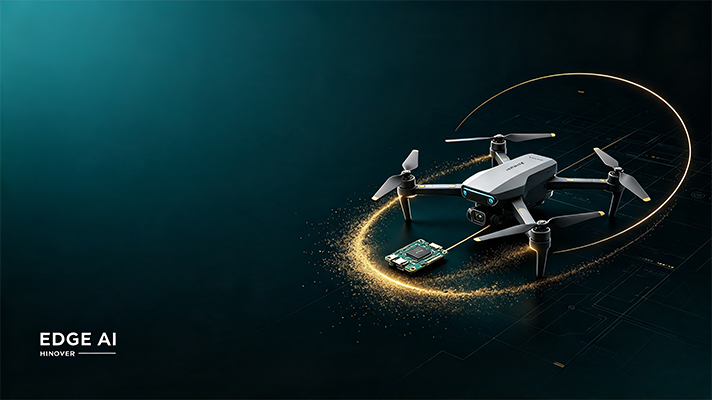
Forty kilometres from the nearest reliable connection, a drone crosses a cooperative field at sixty metres. A patch of stressed crop appears in the frame. The decision to flag it, reroute the next pass, or adjust altitude cannot wait for a round trip to a distant data centre, because there may be no round trip at all. This is the operating reality of edge AI: intelligence that runs inside the machine, at the place where the world is observed. The principles below are drawn from hands-on practice with constrained hardware, including the training and deployment exercises documented by Lucy Hattersley and Brian Jepson in AI Projects with Raspberry Pi (Raspberry Pi Press, 2026), and from HINOVER field engineering in the Sahel.
Training happens once, inference happens everywhere
An AI model has two lives. In training, the model is taught on labelled data by adjusting millions of parameters, a process so computationally heavy that it usually runs on dedicated hardware or in a data centre. In inference, the finished model is applied to new inputs, a far lighter task that a small computer can carry. Confusing the two is the most common design error in autonomous systems: the question is never whether a machine can learn, it is whether the trained model can run, fast enough and cool enough, on the power budget the machine can carry.
Edge deployment follows from that split. A drone does not need a data centre in the air. It needs a model whose inference cost fits its onboard computer.
The physics of intelligence: compute, memory, heat
AI hardware is measured in TOPS, trillions of operations per second. A modern single-board computer without an accelerator delivers roughly half a TOPS. Add-on neural accelerators raise that to thirteen, twenty-six, or forty TOPS, and the most recent boards carry dedicated memory large enough for language models of a few billion parameters. These numbers are not marketing, they are the physical budget of any autonomous machine, together with watts and heat. In the Sahel, where intake temperatures and abrasive dust already stress every component, a model that doubles inference time also doubles the thermal load of a mission.
Quantization is the engineering answer. Model weights stored at full precision are compressed to four-bit or eight-bit integers, shrinking memory and accelerating inference at a small, measurable cost in accuracy. In a published training exercise on a hand-shape classification model, post-training quantization moved validation accuracy from about 83 percent to about 82 percent, a price most field applications pay gladly for a model that fits onboard (Hattersley and Jepson, 2026).
Borrowing a brain: transfer learning
Few organisations train vision models from scratch, and fewer should. Transfer learning takes a network already trained on millions of images, removes its final classification layer, and trains a new, small layer on the classes that matter locally. The exercise in the Raspberry Pi Press book retrains MobileNet V2 to recognise three hand shapes, rock, paper, scissors, in roughly thirty minutes on a well-specified single-board computer. The method generalises directly to field work: the same architecture can be taught to separate crop rows from weeds, or intact infrastructure from damaged infrastructure, with hundreds of labelled images rather than millions.
The discipline lies in the data, not the code. Training images must match the deployment environment: light, angle, background, dust. A model trained on clean studio images will fail gracefully in a laboratory and ungracefully in a field.
Intelligence inside the sensor
The most radical step in edge design removes the computer from the loop entirely. Modern intelligent image sensors run a neural network inside the camera module itself: the sensor converts the scene into tensors, performs inference on its own neural processor, and returns detections rather than pictures. Latency collapses, bandwidth collapses, and privacy improves by architecture, because raw imagery of people and villages never leaves the device unless an operator retrieves it explicitly. For machines that fly over communities, this is not an optimisation, it is a trust mechanism.
Small language models and honest limits
Language models now run locally on constrained hardware, and they are useful: summarisation, translation, command interpretation, code assistance. They are also honest about their nature. A model does not understand words, it predicts tokens, and its failures follow from that: weak arithmetic, confident hallucination, context that fills and expires. Professional practice assigns language models the tasks they suit, keeps calculation and safety-critical decisions in deterministic code, and treats every generated sentence as a draft until verified. On an autonomous machine, the language model advises, the control stack decides.
TinyML: when the brain fits on a microcontroller
Below single-board computers sits a quieter revolution. Microcontrollers costing a few dollars can run stripped-down models trained on gesture, vibration, or acoustic data. The published magic-wand project trains an accelerometer model to recognise a flick and light LEDs in response, a toy on the surface and a pattern underneath: collect sensor readings, label the moments that matter, train, quantize, deploy to a device that can run for months on a battery. The same pattern monitors a pump, a gate, or a mast, reporting anomalies with no cloud dependency at all.
Measure before you trust
Every claim above rests on evaluation. A model is trained on one subset of data and tested on a separate subset it has never seen, because a model that memorises its training set is useless in the field, a failure called overfitting. Regression models are judged by error metrics and the coefficient of determination, classifiers by confusion matrices that expose exactly which mistakes the model prefers. Accuracy targets are set before deployment, not after admiration. An autonomous machine deserves the same standard as any safety-relevant system: evidence, then trust.
What this means at HINOVER
HINOVER builds AI models with vision, navigation, decision, and control capabilities, embedded into autonomous robots and drones. Edge AI is therefore not a feature of our machines, it is their condition of existence: missions must survive broken connectivity, saturated bandwidth, and hostile heat. The principles stay constant: quantize deliberately, transfer rather than retrain, push perception as close to the sensor as possible, keep decisions in verifiable code, and measure everything. The result is technology that assists humanity where assistance is hardest to deliver, built with local hands in Burkina Faso for the Alliance of Sahel States and for partners anywhere.
Readers who want the underlying exercises can work through the open hardware projects in the book's public code repository, and readers who want to see these principles flying can explore our journal or start a conversation through our contact page.